
The Victoria Park Tragedy
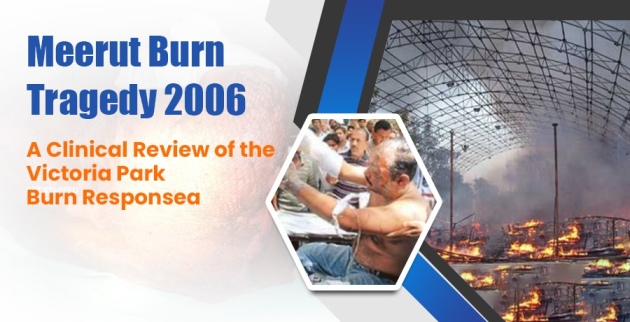
On the afternoon of April 10, 2006, a vibrant consumer electronics fair at Victoria Park in Meerut became one of the largest fire tragedies in recent Indian history. A raging fire swept through the temporary buildings of the fair, rapidly consuming the venue where over 2,000 attendees had gathered.
The speed and intensity of the fire left little time for evacuation, resulting in the tragic loss of over 50 lives on-site. Hundreds of others suffered varying degrees of thermal and inhalation injuries. Amidst the chaos of the disaster, the medical community's response was critical. Seven of the most severely injured patients were identified for specialised tertiary care and transferred to Indraprastha Apollo Hospital in New Delhi. There, they were placed under the immediate supervision of Dr Anup Dhir and his expert burn and reconstructive team. This case study serves as a clinical documentation of their treatment journeys, the surgical philosophies employed, and the successful outcomes achieved.
Patient Demographics and Initial Assessment
In the burn unit, Dr Anup Dhir’s team quickly but carefully evaluated every patient. These included seven individuals between 7 and 52 years old with TBSA (Total Body Surface Area) from 7% to 47%.
|
Patient Initials |
Age |
Gender |
Burn Percentage (TBSA) |
|
P.K.J |
45 years |
Male |
47% |
|
S.D. |
40 years |
Female |
27% |
|
S.G. |
52 years |
Female |
25% |
|
P.G. |
10 years |
Female |
10% |
|
A.G. |
7 years |
Female |
10% |
|
S.D. (M.G.) |
40 years |
Female |
7% |
|
H.T. |
51 years |
Male |
7% |
The effects of such burns, 47% TBSA (Total Body Surface Area) to 7% TBSA (Total Body Surface Area) in a small area, can be devastating and even result in death due to complications. Many victims caught in deadly clouds of toxic smoke and heat had inhalation burns, making the management more complex.
Surgical Approach to Early and Conservative Management
Dr Anup Dhir employed a multilevel clinical severity framework for each case. Management was divided into three basic kinds of methods.
- Early Tangential Excision and Split Skin Grafting: The Gold Standard for Burn Management. Early debridement of the wound (getting rid of dead necrotic tissue) and skin grafting minimise the risk of infection and promotes healing. This helps prevent debilitating sepsis, which may lead to multiorgan failure.
- Late Debridement and SSG(Split Skin Grafting): This approach was used for patients who were initially in severe shock with dangerously low blood pressure, or for those who were not ready for immediate surgery.
- Conservative Management: In cases of minor burns (7–10% TBSA (Total Body Surface Area), advanced wound care and speciality dressings promoted natural healing without invasive surgical intervention.
Case Snippet: Mr. P.K.J(47% Total Body Surface Area)
The case of P.K.J was the biggest challenge for the team. At the age of 45, he suffered 47% total body surface area (TBSA) burns, which carried a very high risk of mortality at that time.
Clinical Challenges of Mr P.K.J Case
P.K.J had a diagnosed inhalation injury that added to the severity of his condition, too. His burns were extensive and second degree, covering the torso, both the left and right arms, including shoulders, forearms, wrists, hands, head pivot and neck. Reconstructive surgery was planned carefully, taking into consideration the location of the burn and the need to conserve function and aesthetic appearance.
Surgical Intervention Timeline
In order to stabilise the patient and initiate reconstruction, Dr Anup Dhir came up with a staged surgical plan:
- April 15th, 2006: Five days post-disaster, the team performed Early Tangential Excision ( surgical procedure for deep dermal and partial-thickness burns) and SSG (Split Skin Grafting) covering 12% of the BSA (Body Surface Area) . This initial step was essential to reducing the “burn load” on the body.
- April 28, 2006: Re-debridement (removal of infected tissue) of the posterior trunk (the top of the shoulders to the lower back) and left upper arm to prepare wound beds for new grafting.
- May 2, 2006: Split Skin Grafting (Post-operative).
- May 12, 2006: Reconstructive surgery was the last major obstacle of note — head and neck skin grafts were made with special care to take in high-mobility areas.
Recovery and Outcome
Despite the seriousness of his injuries, P.K.J did remarkably well under a consistently applied timeline with surgeries spaced out over time as wounds began to heal and carefully monitored postoperative care. He was discharged on May 26, 2006, once he was stable with all the wounds healed. Today, he is a survivor who is willing to share his story — a testimony to the life-saving power of timely and planned burn management by an expert team in a tertiary hospital setting.
Analysis of Other Clinical Outcomes
The Case of S.D. (27% TBSA)
Patient S. D followed the early excision protocol as well on April 15, 2006. Her recovery highlighted the systemic risks of such extensive burn trauma. On standard prophylaxis, she developed mild DVT (Deep vein thrombosis): a serious condition where a blood clot forms in a deep vein, usually in the legs or pelvis, causing swelling, pain, warmth, and redness. However, thanks to the diligence of the Indraprastha Apollo team, this was diagnosed at an early stage and was effectively treated with anticoagulation therapy. She was also discharged on the same day as P.K.J i.e May 26, 2006.
Late Debridement & Conservative Results
The 2 patients who initially declined early excision underwent late debridement and SSG. Although their individual lengths of stay were impacted due to this delay in intervention, both developed excellent graft take and were eventually discharged with no evidence of wound separation. Three conservative treatment patients (A. G., P. G and M. G) had satisfactory recovery without any need for surgical intervention which indicates that high quality of wound care can still be effective in small TBSA (Total Body Surface Area) percentage burns.
Conclusion: Lessons from the Disaster
Dr Anup Dhir and his team who took care of Meerut Fire Victims, with their expert care managed to save all the patients under their care and who went on to have good quality of lives post discharge. Given the severity and complexity of the burns, especially Mr. P.K.J with 47% of TBSA (Total Body Surface Area) burn and inhalation injury, this is a commendable clinical achievement.
Key Clinical Insights and Learning:
- Time Factor: Despite the limited number of cases shared in this study, Case 1 and Case 2 showed that early tangential excision and skin grafting can be associated with improved survival with reduced complication rates. Timing of surgical intervention is important.
- Supportive care: prompt recognition and treatment of complications like infection, deep vein thrombosis and good nutritional support are very important for achieving a good overall outcome in burn patients. This was provided by the team at Apollo Hospital.
- Systemic Needs: The Meerut fire disaster highlights the need for better education and training in fire prevention. Need for a national burn care framework, tertiary burn care units and a national burn disaster management program in India.