
Hair loss affects around 50% of men and women by age 50, with much of it being inherited. The prevalent cause of hair loss in males is "Pattern Hair Loss or Alopecia Androgenetica." It affects the front and top of the scalp in a "U" shape.
Hair transplant surgery moves hair follicles from the donor area on the back and side of the head, which has naturally robust hair, to the recipient area. The Follicular Hair Transplant procedure involves using the roots (follicles/follicular units) of this permanent hair and grafting them in the region where you have lost your hair. There are two methods for doing this: FUT and FUE.
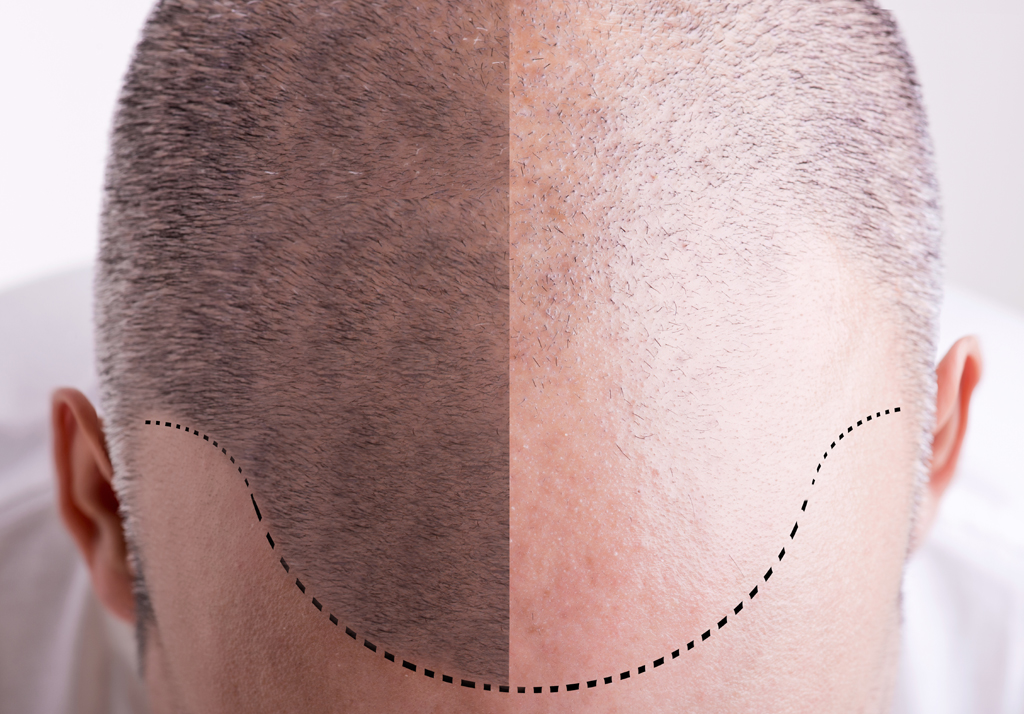

FUT hair transplantation is taking a small strip of hair-bearing scalp from the rear of the head and transplanting it to a bald or thinning area of the scalp.
The surgeon next administers an anesthetic to numb the region where a thin piece of the scalp will be removed. The surgeon closes the scalp after removing the scalp strip with a knife. The hair around it quickly hides this spot.
The scalp strip is then separated under magnification into 500 to 2,000 tiny grafts, each carrying one solitary or a few hairs. The hair type, quality, color, and size of the transplanted region determine how many grafts are utilized.
The surgeon next cleans and numbs the region where the hair will be inserted, uses a scalpel or needle to make holes or slits, and gently places each transplant in one of the holes.
During FUE or Follicular Unit Extraction, hair follicles are extracted from the patient's donor region, transplanted to the recipient area, and put in the recipient's location using a power tool.
The benefit is that there is no linear scar, and no stitches are necessary, so the donor region is barely visible after a few days, and this treatment is helpful for men who prefer to keep their hair short.
Pain relievers and antibiotics are the highly suggested medicines after the FUE and FUT. A surgical bandage will be worn over your scalp for at least a few days after surgery. It takes most patients two to five days to return to work after surgery.
A few months after surgery, new growth should appear after the transplanted hair falls out.
Combined Hair Transplant Technique
(FUE or FUT)
The combined FUE + FUT process is the most modern hair transplant technology. Graft harvesting is employed in this combination of both. The strip method is utilized first, followed by the FUE operation. This process provides substantial graft harvesting, is ideal for bigger bald patches, and provides far better results than either of the procedures.
Are you experiencing hair loss? Dr. Anup Dhir may help you. Fix an appointment now and get back the hair you've always wanted.
Hair loss is not just a cosmetic challenge; it really does hit at your confidence and self-image. Although traditional methods, such as Platelet-Rich Plasma (PRP), have been widely used for many years, modern biotechnology has brought us a better solution: Growth Factor Concentrate (GFC).
We are committed to being at the cutting edge of aesthetic medicine at Dr. Anup Dhir’s practice. We are proud to introduce GFC hair treatment: an advanced non-surgical treatment that ensures your hair loss is stopped and healthy re-growth stimulated by the body itself.
GFC therapy for hair growth isn't just an upgraded version of PRP injections. Using the GFC method removes growth factors from your body in special tubes where they are activated and then injected into areas of the scalp rather than relying on releasing them through injection into a vein.
These growth factors include Proteins with such as Platelet-Derived Growth Factors (PDGF's), Vascular Endothelial Growth Factor (VEGF), and Insulin-like Growth Factors (IGF-1) that are believed to play a significant role in the Cellular rejuvenation.
These mesenchymal cell derived growth factors will awaken inactive or under performing hair follicles to grow new, strong and healthy hairs from the dormant root.
The science behind GFC for hair growth is rooted in precision. The procedure is straightforward but requires medical expertise to ensure sterility and effectiveness:
Because the serum is acellular (without blood cells), the risk of pain and inflammation during the injection is significantly reduced compared to older methods.
Patients who opt for GFC hair treatments frequently experience noticeable enhancements in texture and volume. Key advantages include:
GFC for hair loss is very versatile, but its effectiveness is more if you have thinning hair in the initial or moderate stages. Do you fit the bill?
Note: GFC is frequently used in hair transplants as an adjuvant and to increase the rate of graft survival and density.
Though both treatments rely on your blood, GFC is sometimes called the “next generation” of PRP. With conventional PRP, platelets are injected into the scalp, and we depend on the body to break them down to free growth factors. With GFC hair treatment, the growth factors are already isolated and prepared to begin the rejuvenation once in the scalp. The results of this approach are faster progress and better consistency.
When dealing with hair restoration, the skill of the practitioner matters. Dr. Anup Dhir is a Senior Consultant Plastic & Cosmetic Surgeon with over 30 years of experience. His approach to hair restoration is holistic and medically grounded.
Don't let hair loss dictate your confidence. With GFC treatment for hair, you can harness your body's natural regenerative abilities to restore density and strength.
Contact Dr. Anup Dhir today to schedule a consultation and discover if GFC is the solution you’ve been looking for.

Leave a request to connect to Dr. Anup Dhir for an Appointment.