
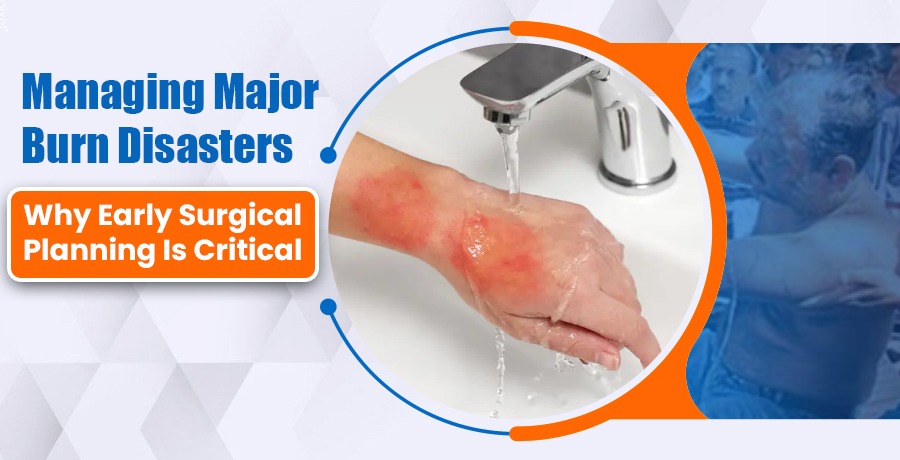
Burn injuries are among the most complex and devastating forms of trauma a person can endure. In the context of a major disaster—whether industrial, environmental, or accidental—the influx of burn victims presents a unique challenge to medical systems. While immediate stabilization and fluid resuscitation are the traditional "first responders" of burn care, medical science has shifted toward a more proactive paradigm: Early Surgical Planning.
The difference between a successful recovery and permanent disability often comes down to the decisions made in the first 48 to 72 hours. This is the reason early intervention forms the base of modern burn disaster management.
1. First step: Preventing Infection and Sepsis
The skin is the body’s principal shield against the world outside. This barrier is torn apart in a significant burn. The “eschar”—that dead, charred tissue that ensues from the burn—is not merely an aesthetic problem; it is a bacteria-festering den.
The Science: No blood supply, no antibiotics: Dead tissue is effectively off the circulatory map. Untreated, bacteria will colonize the eschar and eventually migrate to blood circulation causing sepsis. Opening and effectively closing wounds early (in the first few days) by surgical excision (the removal of necrotic tissue) have been shown to significantly reduce bacterial load, which “closes the door” on life-threatening infections
2. Edema and Compartment Syndrome
After a significant burn, the body’s inflammatory response prompts huge fluid shifts that result in dangerous swelling (edema). In circumferential burns — burns that wrap around a limb (or the torso) — the tight, leathery eschar acts like a tourniquet.
As the tissue beneath continues to swell, pressure accumulates and blood flow to muscles and nerves is restricted. It is called Compartment Syndrome. Early in the surgery, we do procedures that relieve this pressure by performing escharotomies (incisions through the burnt skin). Neglecting to plan for this surgically can result in irreversible muscle death or even amputation
3. Hypermetabolism and Nutritional Support
Burn victims enter a “hypermetabolic” state — the body is burning calories at an astronomical rate trying to repair the damage. The longer the wound stays open and “un-surfaced”, the longer the body remains in this hyped up state.
Because they prepare for an eventual skin graft, the surgeons can “close” the wound. Once the wound is closed, the body’s metabolic demands start to settle down and the patient can preserve their strength for this lengthy rehabilitative process.
4. Mitigating the Long-Term Impact of Scarring
In the development of contractures one of the critical aspects is early surgical planning. When deep burns take their time to heal on their own, the body produces dense and haphazard collagen — which is more commonly known as hypertrophic scarring. The resulting scar tissue is stiff and pulls the skin tight, frequently “locking” joints such as elbows, hands or the neck in place.
Early excision and immediate grafting (or skin substitutes use) allows the healing to happen in a controlled and structured manner. This preventive treatment from day one leads to functional mobility and cutting down on burn scar excision later in life ensuring less social stigma, and into effective intervention till late stage.
The Role of Specialized Care in Disaster Scenarios
Caring for a burn disaster requires coordination that goes beyond general emergency medicine. It takes the skill of a plastic and reconstructive surgeon, who knows how to strike the delicate balance between saving a life and preserving a lifestyle.
In a place where density and industrial rates amplify the odds of such events, like Delhi, access to a surgical roadmap specialized for localized states becomes crucial. Early planning involves:
- Triage and Assessment: Age of patient, Determining depth and percentage of burn accurately
- Staged Procedures: Choosing which areas require immediate grafting and which can be covered by temporary substitutes. Because early skin grafting is done within the first week, urgeons prioritize. The priority areas which are grafted are the Face, Genitals, Hands, and Flexor areas of joints.
- Reconstructive Vision: Appropriate planning for the final range of motion in a patient while still providing acute care.
Conclusion
Burn recovery is a whole process, but the pace is determined in those first few steps. When surgical planning is early, mortality rates are lower, length of hospital stay is shorter and — what may be most valuable — the patient has a far improved quality of life after recovery. By treating the physical trauma before complications such as sepsis or contractures develop, surgeons can turn a catastrophic injury into a manageable recovery.
Specialized Treatment for Burn Recovery and Reconstruction
The process of recovering from a burn injury is both a personal and medical one. Acute trauma or top plastic surgeons for scar reduction surgery in Delhi , expert intervention is there.
Dr. Anup Dhir has decades of experience in reconstructive surgery and burn care, both of which can provide cosmetic and functional recovery.
Start the healing and restoration process.
For information on more detailed burn recovery, read about scar revision at Anup Dhir - Cosmetic & Plastic Surgery .